

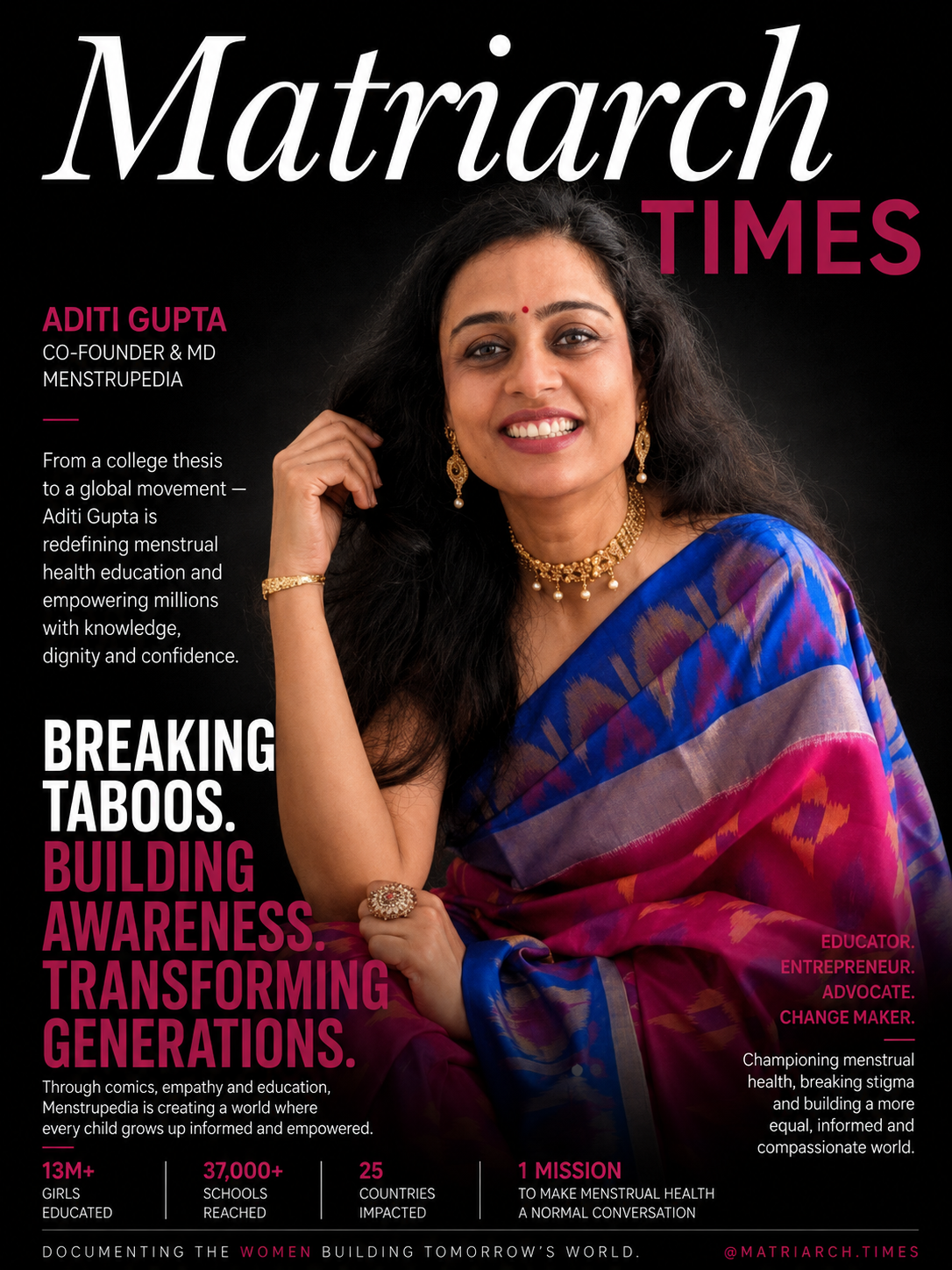
Aditi Gupta has emerged as one of India’s most influential social entrepreneurs, transforming the way menstrual health and puberty education are taught and understood. As the Co-founder and Managing Director of Menstrupedia, she has helped create one of the world’s most recognized menstrual health education platforms, empowering millions of young people through accessible, scientifically accurate, and culturally sensitive learning resources.
Her work has challenged deeply rooted social stigmas surrounding menstruation while demonstrating how innovation, storytelling, and education can drive meaningful social change. Through Menstrupedia, Aditi has not only improved awareness but has also contributed to a broader conversation about dignity, health, and gender equality.
Building a Foundation in Design and Innovation
Aditi Gupta’s journey combines technical education with a strong foundation in design and communication.
She completed her engineering degree before pursuing postgraduate studies in New Media Design at the prestigious National Institute of Design (NID), Ahmedabad. During her time at NID, she began exploring how design thinking could be used to address social challenges and improve public awareness around sensitive topics.
Her academic experience encouraged her to combine research, storytelling, and visual communication to solve real-world problems in an engaging and accessible manner.
Turning Personal Experience Into Purpose
The inspiration behind Menstrupedia came from Aditi’s own experiences growing up in Jharkhand.
Like many young girls, she encountered social restrictions, misinformation, and cultural taboos surrounding menstruation. These experiences sparked a desire to better understand why such stigma existed and how awareness could be improved.
As part of her thesis project at NID, she conducted extensive research into menstrual health education across both rural communities and educated urban populations. Her findings revealed widespread misconceptions and a significant lack of accessible educational resources.
This research ultimately laid the foundation for what would become Menstrupedia.
Launching Menstrupedia to Redefine Health Education
In 2012, Aditi Gupta and her partner, Tuhin Paul, officially launched Menstrupedia with a clear mission: make menstrual health education simple, relatable, and stigma-free.
Rather than relying on traditional educational methods, the platform adopted an innovative approach by using illustrated stories and comic books to explain biological concepts in an engaging manner. This format helped make sensitive topics easier for children, parents, teachers, and communities to discuss openly.
The combination of scientific accuracy, cultural sensitivity, and visual storytelling quickly differentiated Menstrupedia from conventional health education resources.
Creating a Comprehensive Adolescent Wellness Ecosystem
What began as an educational website gradually evolved into a much broader learning ecosystem.
Under Aditi’s leadership, Menstrupedia expanded its educational resources to reach schools, organizations, parents, and educators across multiple regions. The platform also introduced Gulu, a dedicated puberty education initiative designed specifically for boys, helping create a more inclusive approach to adolescent development.
This expansion reflected Aditi’s belief that puberty education should involve all young people and that open conversations can help foster healthier and more informed communities.
Driving Large-Scale Social Impact
One of the most remarkable aspects of Menstrupedia’s journey has been its ability to achieve impact at scale.
The platform’s educational materials have been adopted by thousands of schools, nonprofit organizations, and educational institutions. Through partnerships and curriculum integration efforts, Menstrupedia has helped bring menstrual and puberty education to millions of young learners.
Its resources have reached communities across multiple countries, contributing to improved awareness, confidence, and health outcomes among adolescents.
The organization’s success demonstrates how social entrepreneurship can address systemic challenges through innovative and scalable solutions.
Becoming a Leading Voice for Menstrual Awareness
Beyond building an educational platform, Aditi Gupta has become a prominent advocate for menstrual health awareness and gender-inclusive education.
Through public speaking engagements, awareness campaigns, workshops, and collaborations with organizations, she has consistently promoted evidence-based health education and challenged cultural misconceptions surrounding menstruation.
Her work has encouraged more open conversations about reproductive health while helping normalize topics that were historically considered taboo.
Recognition and Global Influence
Aditi Gupta’s contributions to social impact and health education have earned widespread recognition both in India and internationally.
She has been featured on Forbes India’s 30 Under 30 list, recognized among BBC’s 100 Most Influential Women, and gained national visibility through her appearance on Shark Tank India. Her achievements reflect the growing importance of education-driven social innovation in addressing public health challenges.
She is also a TED speaker and has collaborated with leading organizations and consumer brands to further expand awareness around menstrual health and adolescent wellness.
Building a Lasting Legacy Through Education
A defining characteristic of Aditi Gupta’s journey is her ability to transform a deeply personal challenge into a global educational movement. By combining research, design, storytelling, and social entrepreneurship, she has created a platform that empowers young people with knowledge while helping dismantle long-standing social stigmas.
Today, Aditi Gupta stands among India’s most impactful social entrepreneurs. Through Menstrupedia, educational advocacy, and public awareness initiatives, she continues to advance menstrual health literacy and adolescent wellness while inspiring a new generation of changemakers to build solutions that create meaningful social impact.
Leave a Reply